Introduction
When purchasing medium voltage switchgear, one of the most common questions from engineers and procurement teams is: How much does MV switchgear cost?
Unlike standard electrical components, MV switchgear is an engineered power distribution solution. The final MV switchgear price depends on multiple factors, including voltage level, rated current, short-circuit capacity, switchgear configuration, protection requirements, and project specifications.
Understanding these cost factors helps customers evaluate MV switchgear price more accurately, select the right solution, avoid unnecessary expenses, and achieve a better balance between initial investment and long-term reliability.
How Much Does MV Switchgear Cost?
There is no fixed price for medium voltage switchgear because each project has different technical requirements. Therefore, the actual MV switchgear price is determined by the complete technical configuration rather than only the voltage rating or equipment size.
The quotation is usually determined by:
- Rated voltage
- Rated current
- Short-circuit breaking capacity
- Number of switchgear panels
- Circuit breaker selection
- Protection and control system
- Switchgear type
- Testing requirements
- Customer standards
For example, a standard 11kV switchgear lineup for an industrial distribution system will have a different cost compared with a customized 33kV metal-clad switchgear system with advanced protection and automation functions.
To provide an accurate MV switchgear quote, manufacturers usually require project information such as a single-line diagram (SLD), technical specifications, and protection requirements.
MV switchgear is commonly designed according to IEC 62271 series standards.
Key Factors Affecting MV Switchgear Price
1. Voltage Rating
Voltage level is one of the main factors influencing switchgear cost.
Higher voltage systems require:
- Stronger insulation performance
- Larger electrical clearances
- Higher voltage-rated components
For example, 33kV switchgear generally requires more advanced insulation design than 11kV switchgear, resulting in higher manufacturing costs.
2. Rated Current
Rated current determines the size of conductors and busbars inside the switchgear.
Common ratings include:
- 630A
- 1250A
- 2500A
- 3150A
Higher current ratings require:
- Larger copper busbars
- Improved thermal performance
- Stronger mechanical structures
Therefore, a 3150A switchgear lineup will normally cost more than a 630A configuration.
3. Short-Circuit Breaking Capacity
The short-circuit capacity determines the ability of switchgear to safely interrupt fault currents.
Higher fault levels require:
- Higher-performance vacuum circuit breakers
- Stronger enclosure structures
- Additional testing
Common short-circuit ratings include:
- 16kA
- 20kA
- 25kA
- 31.5kA
- 40kA
A higher short-circuit rating usually increases the overall MV switchgear cost.
4. Number of Switchgear Panels
The number of panels has a direct impact on the final project price.
A typical MV switchgear lineup may include:
- Incoming feeder panels
- Outgoing feeder panels
- Transformer protection panels
- Bus sectionalizer panels
- Metering panels
- PT panels
More panels mean additional:
- Circuit breakers
- Protection devices
- Busbars
- Enclosure materials
- Testing procedures
For large industrial or utility projects, the number of panels is often one of the largest cost factors.
5. Switchgear Type and Design
Different MV switchgear technologies have different price levels.
Air Insulated Switchgear (AIS)
AIS is one of the most economical medium voltage solutions.
Advantages:
- Un investissement initial plus faible
- Simple maintenance
- Mature technology
AIS is commonly used in industrial plants and substations where installation space is available.
Metal-Clad Switchgear
Metal-clad switchgear provides enhanced safety through compartmentalized construction.
Advantages:
- High operator safety
- Reliable operation
- Easy maintenance
- Suitable for critical power systems
Because of its advanced design and construction requirements, metal clad switchgear price is generally higher than standard MV switchgear.
Gas Insulated Switchgear (GIS)
GIS provides a compact solution using gas insulation technology.
Advantages:
- Small footprint
- High reliability
- Suitable for space-limited applications
However, GIS usually has a higher initial cost due to advanced manufacturing processes and specialized components.
When comparing different switchgear technologies, customers should consider not only the initial equipment cost but also how each design influences the overall MV switchgear price throughout the project lifecycle.
MV Switchgear Price Comparison by Type
| Type d’appareillage de commutation | Cost Level | Typical Applications |
|---|---|---|
| AIS | Lower | Industrial distribution, substations |
| Metal-Clad Switchgear | Medium | Utilities, factories, infrastructure |
| GIS | Higher | Urban substations, limited-space projects |
The most suitable solution depends on project requirements, available space, maintenance strategy, and budget.
Protection System and Components Affect MV Switchgear Cost
The protection and control system can significantly influence the final quotation.
Important components include:
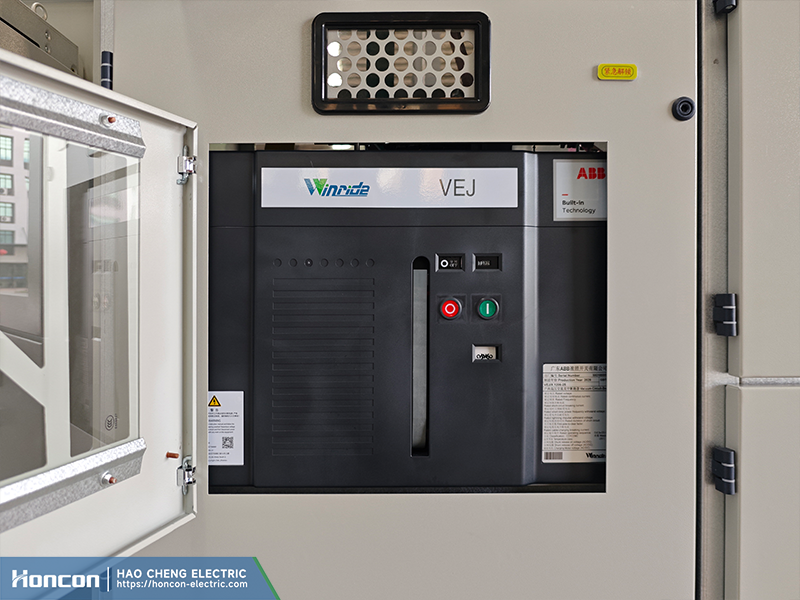
Vacuum Circuit Breaker
The circuit breaker rating affects:
- Voltage level
- Current capacity
- Breaking capacity
- Mechanical endurance
Higher-performance circuit breakers increase equipment cost but provide improved reliability.
Protection Relay
Protection requirements vary depending on the application.
Common functions include:
- Overcurrent protection
- Earth fault protection
- Differential protection
- Communication functions
Advanced numerical relays with communication capabilities provide more functions but also increase cost.
How to Get an Accurate MV Switchgear Quote
To receive an accurate MV switchgear price quotation, customers should provide complete project information, including electrical parameters, system configuration, and applicable standards.
Before requesting a quotation, customers should prepare:
Electrical Information
- Rated voltage
- Rated frequency
- Rated current
- Short-circuit level
- Protection requirements
System Configuration
- Single-line diagram
- Number of incoming feeders
- Number of outgoing feeders
- Transformer ratings
Installation Conditions
- Indoor or outdoor installation
- Ambient temperature
- Altitude
- IP protection requirements
A complete specification allows suppliers to provide a more accurate and optimized solution.
Tips to Reduce MV Switchgear Cost
Reducing cost does not always mean selecting the cheapest supplier.
Practical methods include:
- Choosing the correct voltage and current rating
- Avoiding unnecessary over-specification
- Using standardized switchgear configurations
- Selecting suitable protection functions
- Working with an experienced manufacturer
A professional supplier can often reduce project costs through optimized engineering rather than simply reducing equipment quality.
Conclusion
The final MV switchgear price depends on much more than the equipment itself. Voltage level, configuration, protection system, switchgear type, and project requirements all influence the final quotation.
By understanding these factors and providing complete technical information, customers can select a reliable and cost-effective medium voltage switchgear solution for industrial, utility, and infrastructure applications.
The main factors include voltage rating, rated current, short-circuit capacity, number of panels, protection system, and customization requirements.
The cost depends on the switchgear configuration, number of panels, protection requirements, and selected components. A detailed technical specification is required for an accurate quotation.
Manufacturers typically require a single-line diagram, voltage level, current rating, short-circuit capacity, protection requirements, and applicable standards.