Reactive power compensation is critical for improving power factor and ensuring stable system operation. Common compensation and phase compensation mainly differ in how capacitor banks are switched, and understanding this distinction helps engineers select the right solution.
What Is Common Compensation?
In traditional systems, contactors operate in three-phase mode. When the contactor closes, all three phases are switched simultaneously, and the capacitor bank compensates reactive power as a whole. This method is known as common compensation.
This type of reactive power compensation works well when the three-phase load is relatively balanced. It features simple control logic, low cost, high reliability, and easy maintenance. Each capacitor group requires only one control signal.
However, when phase imbalance is significant, this approach may not correct reactive power effectively and can even aggravate imbalance.
What Is Phase Compensation?
In many practical applications, loads are unevenly distributed across phases. Single-phase equipment connected between two phases often causes imbalance.
Phase compensation allows capacitors on phases A, B, and C to be switched independently using composite switches or thyristor modules. This form of reactive power compensation adjusts each phase according to its actual demand, improving accuracy in unbalanced systems.
The trade-off is higher cost, more complex wiring, and greater controller requirements, as each capacitor group needs multiple control signals.
How to Choose the Right Method
The selection should be based on the degree of phase imbalance. If imbalance is within 15%, common compensation is usually sufficient, as utilities typically assess average power factor.
Phase imbalance is calculated as the difference between the maximum and minimum phase currents divided by the minimum phase current. When imbalance exceeds this range, phase compensation becomes necessary.
In many projects, a combined reactive power compensation solution is used. For example, with a total capacity of 420 kVar and an imbalance of 20%, about 84 kVar can be allocated to phase compensation, while the remaining capacity uses common compensation. This approach balances performance, cost, and system complexity.
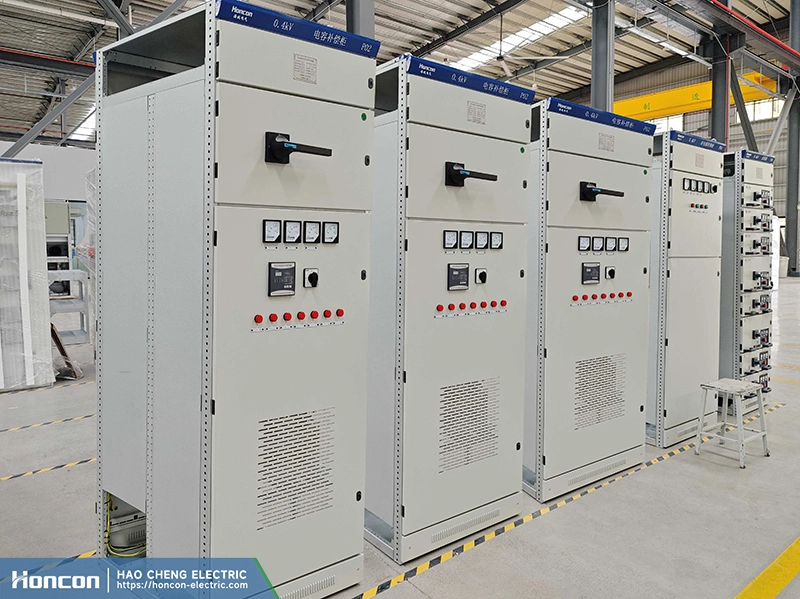
For reliable reactive power compensation, Haocheng Electric provides high-quality capacitor compensation cabinets to meet your project requirements.
FAQ
When is common compensation sufficient?
When three-phase load imbalance is within 15%.
Why is phase compensation more expensive?
It requires independent switching, more control signals, and more complex wiring.
Can both methods be combined?
Yes. Mixed solutions are widely applied in modern power systems.
Please subscribe to our Youtube Channel to learn more:Honcon.